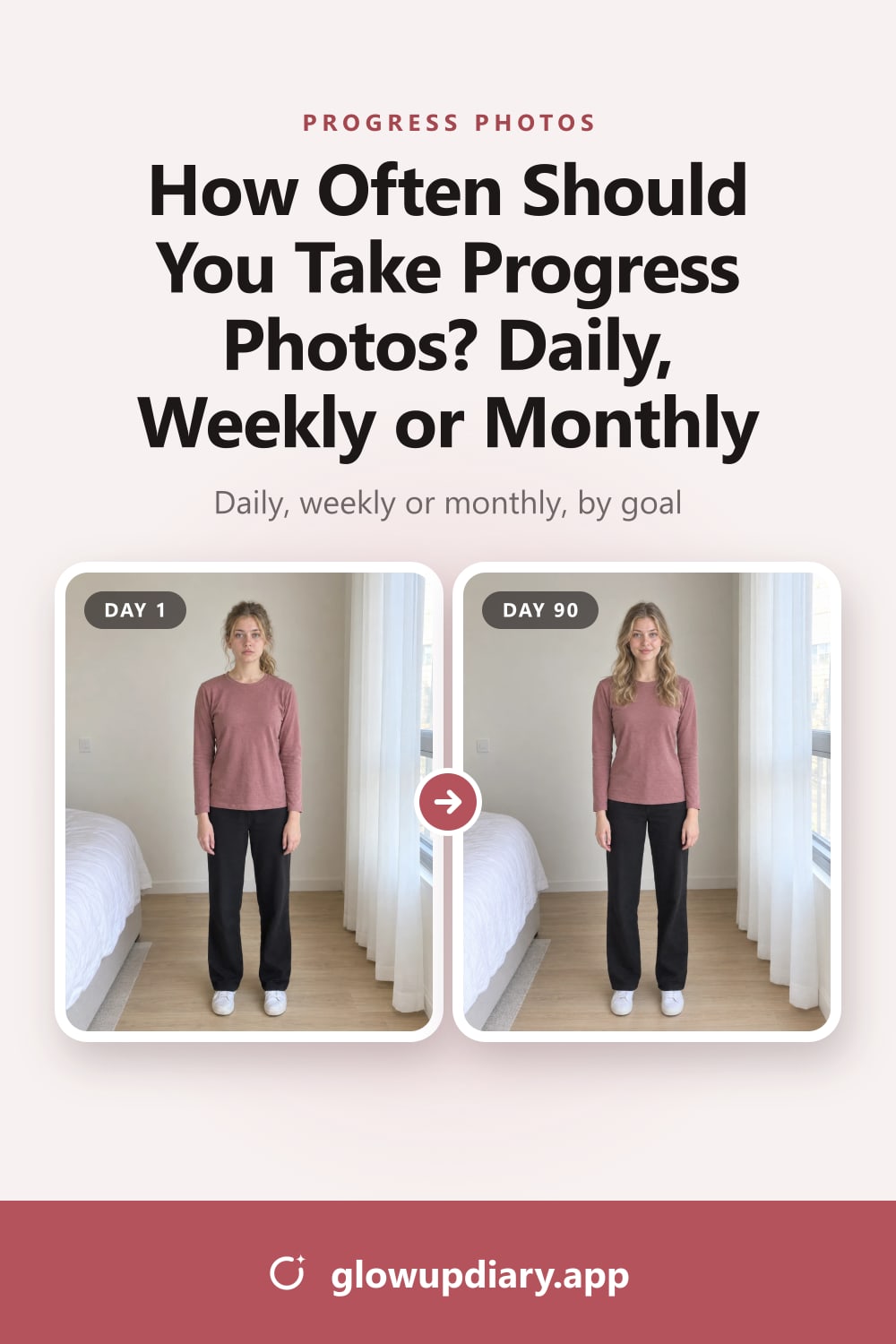
How Often Should You Take Progress Photos? Daily, Weekly or Monthly
Daily, weekly or monthly? How often to take progress photos for fat loss, muscle, skin and a 90-day glow up, and when to compare them so you actually see change.
On this page
- Shoot often, compare rarely
- Daily vs weekly vs monthly progress photos
- How often to take progress photos, by goal
- When to compare: a milestone schedule
- Why yesterday vs today shows you nothing
- Does taking photos every day actually help?
- When to take fewer photos
- How to make daily photos stick
- FAQ
- Sources
How often should you take progress photos? Ask ten coaches and you’ll hear ten answers, from every day to once a month. The confusion comes from mixing up two different questions: how often you take photos, and how often you compare them. Get those two right and progress photos finally start showing you something.
Here’s how often to take progress photos for fat loss, muscle, skin and a 90-day glow up, when to compare them, and when taking fewer is the better choice.
Shoot often, compare rarely
Taking a photo and judging a photo are two separate habits, and they work best at different speeds.
- Taking photos is cheap. It takes about a minute, and the more often you do it, the more automatic it gets. A daily photo also gives you every day of your journey in a row, which is what you need for a before-and-after video.
- Comparing photos is where the frustration lives. Real change in your body or skin is small from one day to the next, much smaller than the differences that light, posture and water make. Compare too often and you mostly see noise.
So the rule is simple: shoot on a fixed rhythm, and compare in bigger steps.
Daily vs weekly vs monthly progress photos
| Daily | Weekly | Monthly | |
|---|---|---|---|
| Best for | A 90-day challenge, skin, building the habit | Fat loss, muscle, busy weeks | Long, slow goals, like a year of training |
| Upside | Becomes automatic, gives you a full time-lapse, a bad photo day doesn’t matter | Easy to keep up, still shows the trend | Very little effort |
| Downside | Tempting to compare day to day | A bad photo day counts for more | Easy to forget, and a bad month goes unnoticed for a long time |
| Compare | Against Day 1 at milestones | Every 2 to 4 weeks | Month to month |
If you can’t decide, start daily. Skipping a day of a daily habit costs nothing. Skipping a week of a weekly one means a month with only three photos.
How often to take progress photos, by goal
For weight loss
Take photos daily or weekly, first thing in the morning, and compare every 2 to 4 weeks.
The reason is the size of the change. The CDC says people who lose weight gradually, at about 1 to 2 pounds a week, are more likely to keep it off (CDC). Meanwhile, your body weight can move within a window of about 5 to 6 pounds over a single day, mostly from water (Cleveland Clinic). One week of real fat loss can easily hide behind one salty dinner. Four weeks usually can’t.
If you have periods, compare photos taken at the same point in your cycle, or look at the trend across several comparisons, because hormones can make you hold extra water for a few days.
For building muscle
Once a week is plenty. Compare once a month.
Muscle size changes more slowly than fat or skin, so weekly photos rarely look different from each other. Keep a simple training log alongside them: the weights and reps you lift will show progress weeks before your photos do. Take a flexed set too if you like, but only ever compare flexed with flexed.
For skin and acne
Take skin photos daily or every few days, and compare every 2 to 4 weeks.
The American Academy of Dermatology says it may take several weeks to a few months to see a difference from acne treatment (AAD). Frequent photos help you spot what made a breakout flare, but the comparison that tells you whether your routine works is week 4 against Day 1, then week 8 against Day 1. Shoot with bare skin, hair back and the same window light every time. Our skincare routine for a glow up covers what to pair the photos with.
For a 90-day glow up
Take a photo every day, and compare Day 1 with day 7, 14, 30, 60 and 90.
A glow up mixes everything: skin, body, posture, sleep and style. Daily photos give you the full story, and the milestones give you a reason to keep going. Ninety daily photos also make a far better film at the end than thirteen weekly ones. Here’s how to glow up in 90 days, phase by phase.
| Goal | Take photos | Compare against Day 1 |
|---|---|---|
| Weight loss | Daily or weekly | Every 2–4 weeks |
| Building muscle | Weekly | Monthly |
| Skin and acne | Daily or every few days | Every 2–4 weeks |
| 90-day glow up | Daily | Day 7, 14, 30, 60 and 90 |
| Long-term training | Weekly or monthly | Every 1–3 months |
When to compare: a milestone schedule
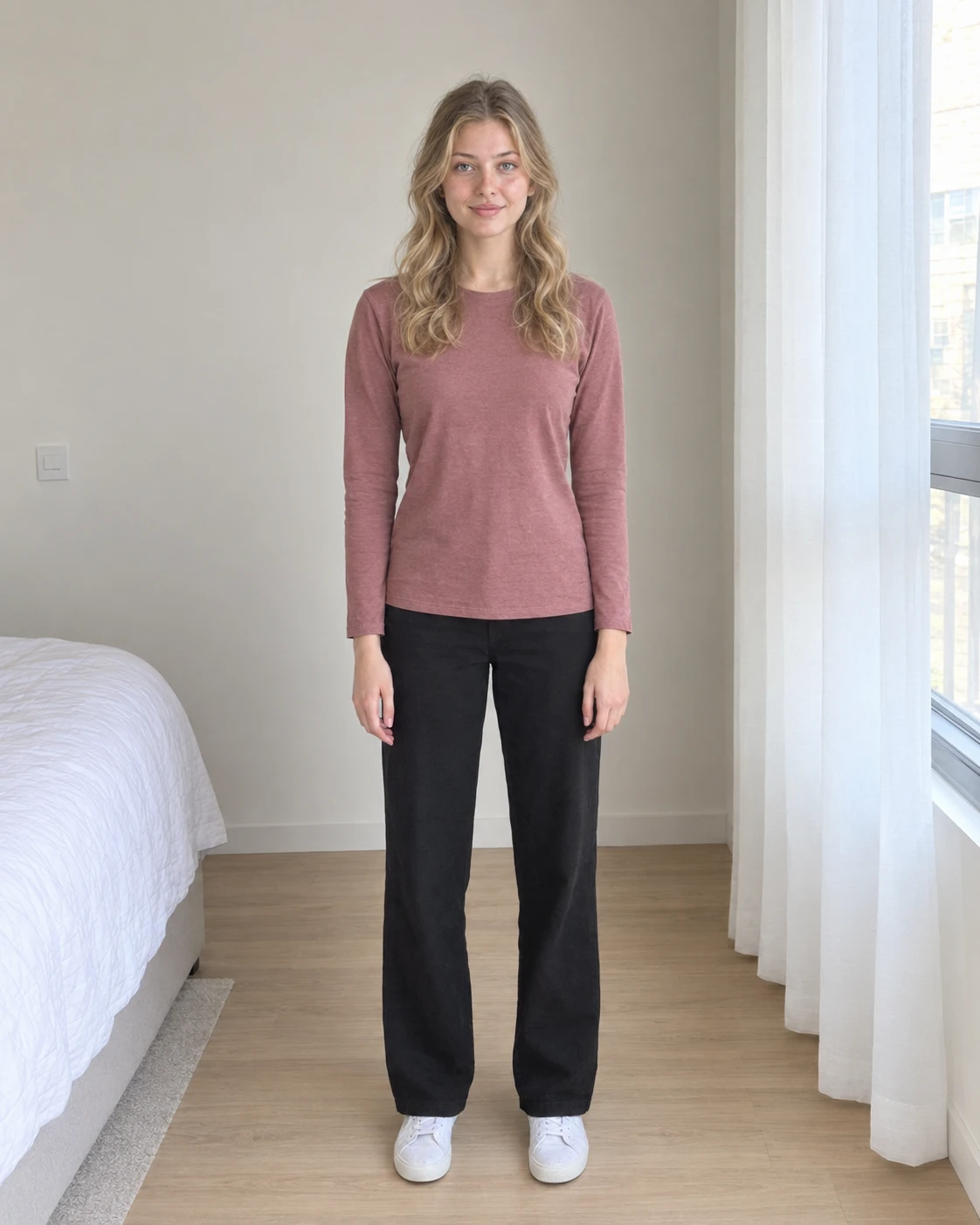
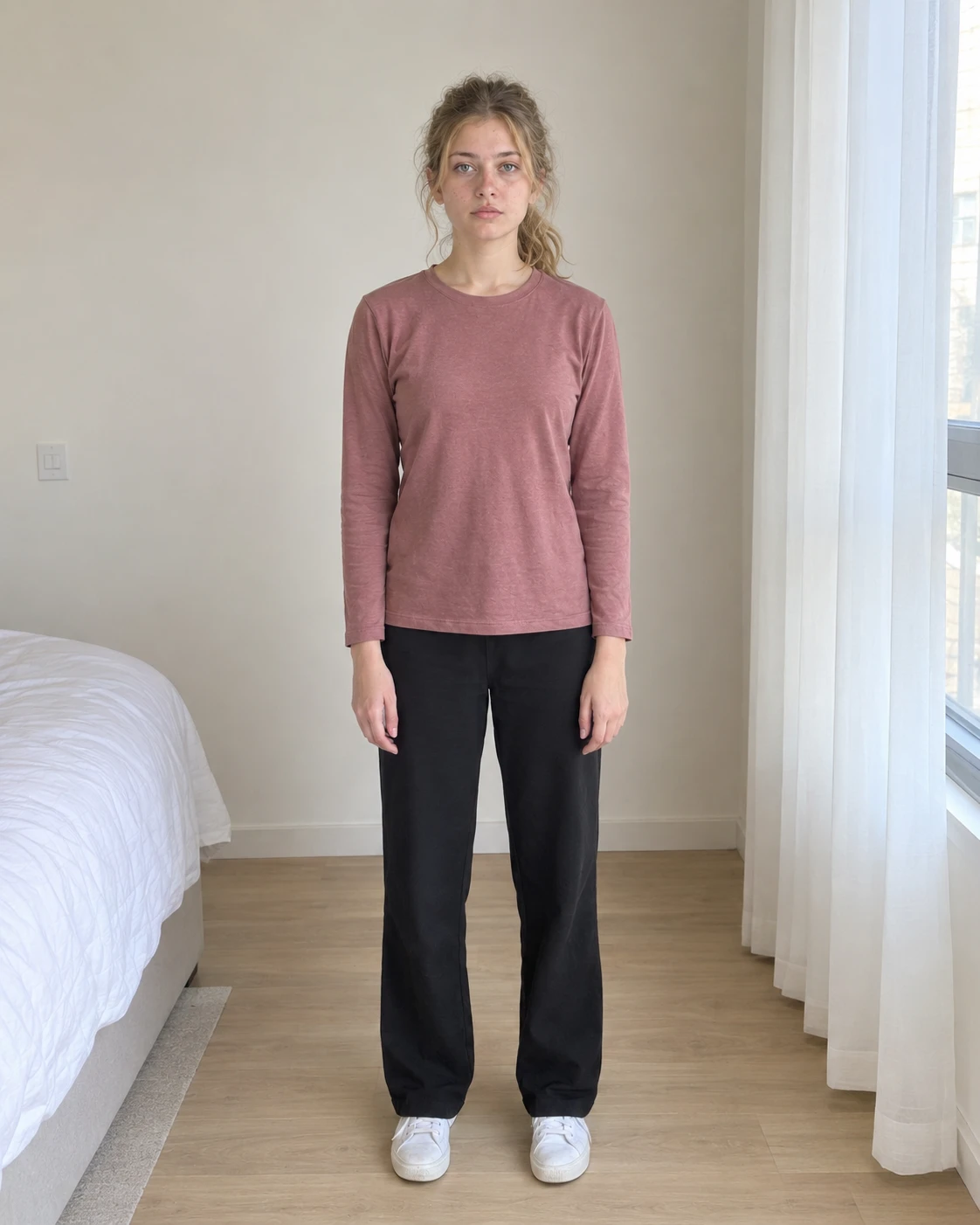
Always compare against Day 1, not against last week. Your first photo doesn’t move, so it’s the only fair reference.
-
Days 7 and 14
Check your setup
- Do the photos line up? Same spot, same light, same distance?
- Fix anything that drifts now, before it ruins a month of photos.
- Expect little or no visible change yet. That is normal.
-
Day 30
The first real comparison
- Small changes start to show: posture, bloating, skin calmness.
- Write down one thing that changed and one thing to adjust.
- Add a number that moves slowly, like your weekly waist measurement.
-
Days 60 and 90
The comparisons that count
- Side-by-side differences are usually clear by now if you stayed consistent.
- Compare Day 1 with day 90, not day 89 with day 90.
- Watch every day in a row as a time-lapse to see the trend.
Why yesterday vs today shows you nothing
Put two photos taken a day apart side by side and you’ll almost always find a difference. The trouble is what causes it:
- Water. Salt, alcohol, a hard workout and your cycle all change how much water you hold. Cleveland Clinic names water retention as the most common cause of short-term weight swings (Cleveland Clinic).
- Food. A big dinner can change how your stomach looks the next morning.
- Light. A cloudy day flattens shadows, and a sunny one deepens them.
- Posture. Standing a little straighter or more relaxed changes your outline more than a week of progress does.
None of that is progress, and all of it is bigger than one day of real change. That’s why the setup matters as much as the schedule. Here’s how to take progress photos that actually show change, from the spot to the pose.
Does taking photos every day actually help?
Probably, as long as daily photos don’t turn into daily judging. A systematic review found a consistent link between self-monitoring and weight loss, though the authors note that the quality of the evidence was weak. In one small study, people who weighed themselves every day lost more weight over six months than people who weighed less often (Steinberg and colleagues, 2015). It wasn’t designed to prove the daily habit caused the difference, but it fits what many people find: a small daily check-in keeps you engaged.
Photos have one advantage over the scale. They show shape, posture and skin, the things you actually care about, instead of one number that swings with water.
When to take fewer photos
Progress photos should make you feel more in control, not less. If you notice yourself checking your photos many times a day, zooming in on one feature, or feeling worse after every look, take them less often and stop comparing for a few weeks.
How to make daily photos stick
- Tie it to something you already do. Right after you brush your teeth in the morning is ideal: same time, same state, every day.
- Leave the setup ready. Keep the phone stand where it lives and the tape marks on the floor, so a photo takes one minute, not five.
- Use a reminder. A daily nudge does the remembering for you.
- Don’t look at today’s photo. Take it and move on. Save the looking for your milestones.
- Missed a day? Carry on. One missing photo doesn’t break the record. Quitting does.
Not sure where to keep them? Our honest comparison of the best progress photo apps covers the options, from your camera roll to dedicated apps.
Frequently asked questions
Should I take progress photos every day?
You can, and it's the easiest way to make it a habit and to build a time-lapse of your journey. Just don't compare today with yesterday. Daily differences are mostly water, light and posture, so compare against Day 1 every couple of weeks instead.
How often should I take progress pictures for weight loss?
Daily or weekly, at the same time and in the same spot. Compare every 2 to 4 weeks. At the CDC's suggested pace of 1 to 2 pounds a week, a single week is often too small a change to see past normal water swings.
How often should I take progress photos when building muscle?
Once a week is plenty. Muscle size changes slowly, so compare once a month and keep a training log. Your strength numbers will show progress before the photos do.
How often should I take skin progress photos?
Daily or every few days, in the same light, with bare skin. Compare every 2 to 4 weeks. The American Academy of Dermatology says acne treatment can take several weeks to a few months to make a visible difference.
Is it bad to take progress photos too often?
Taking them often isn't the problem. Checking them often can be. If you find yourself studying your photos many times a day or feeling worse after every look, take them less often, compare only at milestones, and talk to a doctor if it keeps bothering you.
What day of the week should I take progress photos?
Any day, as long as it's the same one each week, at the same time of day. Many people choose a weekday morning, because salty meals and alcohol at the weekend can leave you holding extra water.
How long before progress photos show a difference?
Usually a few weeks for small changes and around three months for a difference that's obvious side by side. It depends on your goal, your starting point and how consistent you are.
Sources
- Weight fluctuations. Cleveland Clinic Health Essentials
- Steps for losing weight. Centers for Disease Control and Prevention
- Acne: Tips for managing. American Academy of Dermatology
- Self-monitoring in weight loss: a systematic review of the literature. Burke LE, Wang J, Sevick MA. Journal of the American Dietetic Association, 2011
- Weighing every day matters: daily weighing improves weight loss and adoption of weight control behaviors. Steinberg DM, et al. Journal of the Academy of Nutrition and Dietetics, 2015
- Body dysmorphic disorder (BDD). NHS